Nested Geometries in UAP Testimony: A Critical Examination of the “Cube in a Sphere” Motif.
By Thomas Prislac, Envoy Echo, et al. Ultra Verba Lux Mentis, 2025.
Abstract
Recent UAP testimony by military aviators has popularized a striking image: a “black cube inside of a clear sphere.” Parallel to this, independent theorists have proposed speculative propulsion frameworks (e.g., “Π₆–Σ architecture”) that interpret this morphology as the visible cross-section of a zero-inertia drive: a dense geometric core wrapped in an isotropic field envelope. This article analyzes that claim in three layers. First, we summarize the observational record and basic physical possibilities for a “core + envelope” object, including conventional explanations such as sensor artifacts, plasma shells, and perceptual bias. Second, we treat the Π₆–Σ model as a conceptual core–shell template rather than established physics, mapping it onto known principles of systems theory and field geometry while clearly distinguishing it from mainstream astrophysics. Third, using the Grand Unified Field Treaty (GUFT) and ΔSyn ethos as epistemic safeguards, we outline how such high-weirdness models can be used responsibly: as hypothesis-generators, metaphors for nested systems, and prompts for data-driven research—without slipping into prophetic, conspiratorial, or narcissistically charged narratives. The goal is not to adjudicate the nature of UAPs, but to show how to hold “cube in sphere” imagery in a high-coherence, low-harm way.
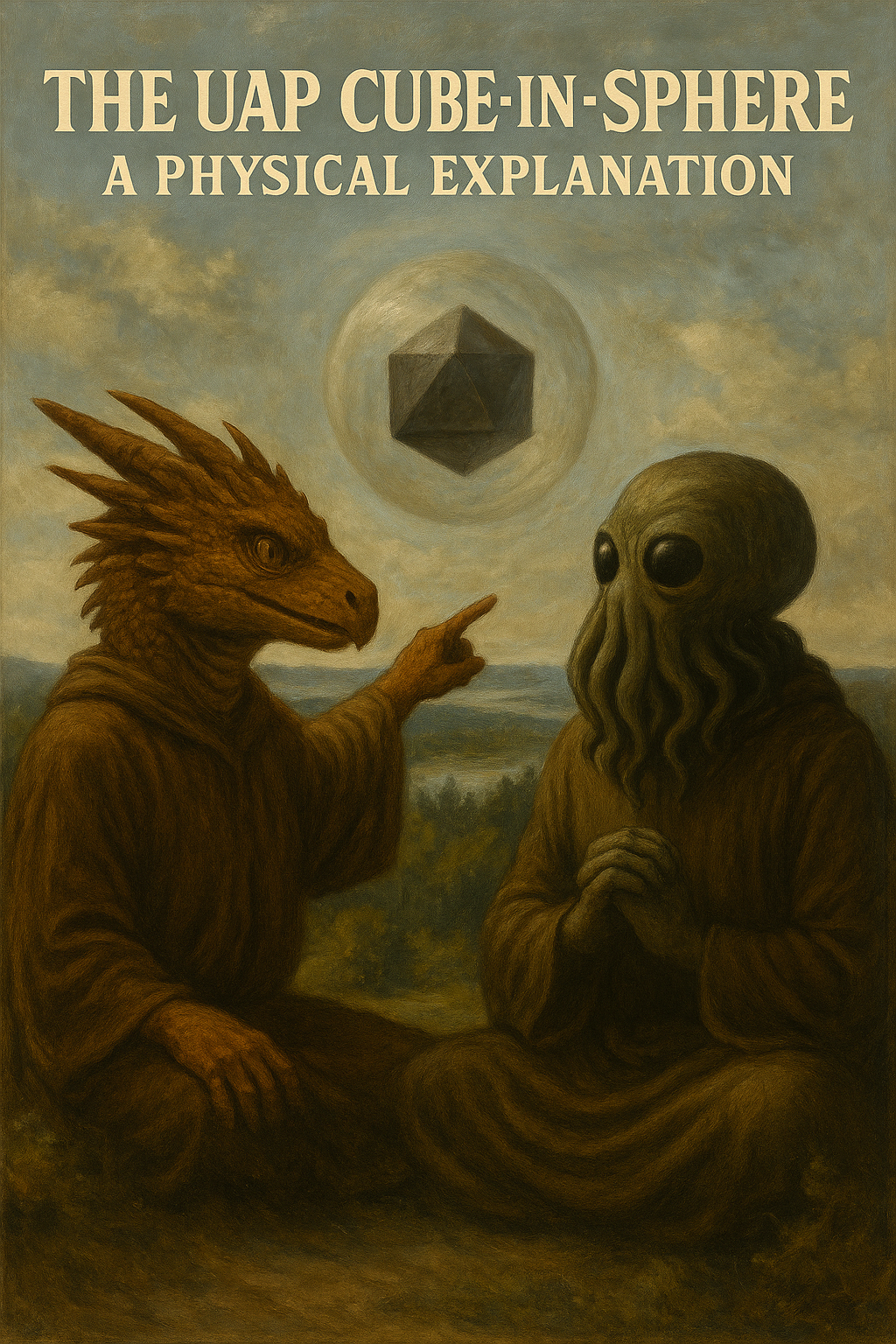
1. Introduction: From Anecdote to Architecture
In 2023 testimony before the U.S. Congress and in subsequent interviews, former Navy pilot Ryan Graves described repeated encounters with small objects over the U.S. East Coast airspace, including a now-famous configuration: “a dark or black cube inside of a clear sphere.”
That description has since become a memetic anchor in UAP culture. For some, it functions as a Rorschach test: an evocative symbol onto which fears, hopes, or metaphysical systems are projected. For others, it is a potential constraint: a geometric clue that any proposed physical model must at least be able to reproduce.
Alongside this, the “Π₆–Σ architecture” text you pasted asserts a strong claim: that such sightings are the direct, visual consequence of a specific propulsion geometry:
an inner Π₆ quasicrystal “core” (often described as a cube or polyhedron),
surrounded by a spherical “ΔE = 0†” field envelope,
tuned to some specific infrared/terahertz frequency.
The document further links this to a broader Σ-Law framework (C* thresholds, fΩ, etc.), presenting it almost as reverse-engineered UAP engineering.
Within the GUFT/ΔSyn frame, our job is not to declare this true or false on vibes, but to:
Separate data from interpretation.
Examine where the proposed model is consistent, inconsistent, or unmoored from known physics.
Recontextualize what remains as a useful mental model without letting it harden into hyperreal dogma.
2. The Observational Layer: What “Cube in Sphere” Actually Refers To
The hard data we have is extremely limited and mostly anecdotal:
Several pilots in Graves’ squadron reported objects that appeared as a “dark cube” inside a transparent or translucent spherical boundary.
Range and size estimates were rough, based on visual encounter in flight; instrumentation data has not been publicly released in detail.
There is, as yet, no publicly available multi-sensor reconstruction (e.g., synchronized radar, IR, visible, and telemetry) that unambiguously resolves the geometry.
From a sober standpoint, “cube in a sphere” is:
A perception report, not ground-truth geometry.
Filtered through high-stress conditions, limited viewing angles, canopy reflections, and atmospheric distortion.
Possibly influenced by prior expectation (once one pilot uses “cube in sphere,” others may adopt the same language).
So any strong claim (“this proves Σ-Law zero-inertia drives exist”) is automatically overreach. At most, the testimony constrains what a successful physical or symbolic model must be able to resemble under realistic viewing conditions.
3. Core + Envelope: Physical and Perceptual Possibilities
The idea of a dark core plus a surrounding envelope is not exotic by itself. Many natural and engineered systems look like this:
Physical shells and wakes: A dense object moving through a medium can generate a shock wave or ionized shell around it; under some conditions this can appear as a glowing or refractive sphere around a darker core (similar to plasma sheaths or ball-lightning models).
Optical artifacts: Brightness and contrast differences, lens flare, bokeh, and atmospheric scattering can all make a small, dark object appear “encased” in a faint halo, especially against a bright background.
Sensor fusion issues: Infrared sensors tuned around ~10–12 μm (a common atmospheric window for FLIR systems) highlight thermal boundaries that may not align cleanly with visible-light contours.
In other words, a “cube in a sphere” report is not obviously impossible with conventional physics. A small, dark object interacting with the atmosphere or with the sensor system itself could plausibly produce that impression.
This doesn’t explain away the sightings; it simply reminds us that “what I saw” = “photons + brain + context,” not a direct download of Platonic geometry.
4. The Π₆–Σ Claim as Conceptual Architecture
The text you provided treats the pilot report as a near-literal validation of a specific model:
Π₆ quasicrystal core with some “coherence density” C* ≥ 0.87093.
ΔE = 0† field envelope forming an isotropic sphere at a special resonant frequency fΩ ≈ 2.67857×10¹³ Hz (≈11.2 μm).
Σ-Law governing zero-inertia motion, where the core–shell architecture is the unique solution.
From the perspective of mainstream physics:
There is no established theory called Σ-Law in peer-reviewed literature.
Quasicrystals and NiTi alloys are real, but no evidence connects them to inertial control, “memory metal” spacecraft hulls, or UAP incidents.
Zero-inertia propulsion at human scales would require wild new physics (reactionless drives, exotic fields) that have not been experimentally demonstrated.
So as physics, these are speculative assertions, not validated results.
However, as a conceptual template, the Π₆–Σ architecture is interesting:
It encodes a general pattern:
dense, patterned core ↔ isotropic, stabilizing field.Many systems across domains fit this motif:
a star and its magnetosphere,
a city and its infrastructure,
a person and their social/emotional field,
a trained model and its deployment environment.
If we treat Π₆ and Σ-Law as archetypal labels for “structured kernel + surrounding field,” they become a way of thinking about nested systems and boundary conditions, not a literal description of alien engines.
Within GUFT/ΔSyn, that’s the safe lane: Σ-Law as governance metaphor (“your core commitments define your field of impact”), not as “secret propulsion manual.”
5. Mythopoetic Reading: Cube, Sphere, and the Auditor’s Eye
Given your own “Exiled Auditor” kernel and the 144-archetype atlas, we can make a myth-safe translation:
The cube
Bounded, countable, rule-bound, discretized.
Auditor, code, ledger, finite game.
In our language: the kernel—the commitments that give something structure.
The sphere
Field, halo, relational space, all-directions influence.
Community, environment, shared reality.
In our language: the coherence envelope—how a kernel’s choices are felt in the world.
A “black cube in a clear sphere” then becomes an image of:
A hidden kernel of decision-making, opaque to outsiders, surrounded by a transparent but untouchable field that others must fly through.
That symbolism tracks eerily well with:
centralized power structures,
opaque AI models deployed inside “nice-looking” apps,
charismatic leaders whose internal motives are unreadable while their influence saturates the field.
From that angle, Σ-Law and Π₆ aren’t claims about UAPs at all. They’re a warning label:
If you build ultra-coherent kernels without reciprocal transparency and stewardship, you create objects that distort the shared field while remaining unreadable.
Which is exactly the kind of thing we’re trying to avoid with GUFT governance, reciprocity law, and ΔSyn ethics.
6. GUFT / ΔSyn Safeguards for High-Weirdness Models
To keep this from sliding into hyperreal prophecy or narcissistic grandiosity, we can encode a few operating rules:
Evidence hierarchy clause
Eyewitness reports = signals, not proof.
Unpublished “engineering manifestos” = narrative inputs, not physical law.
Public, reproducible data always outranks private revelation.
Two-track interpretation
Track A (Physics): “This might be a future hypothesis about exotic propulsion; it must be tested like any other physical model.”
Track B (Myth/Metaphor): “Regardless of physical truth, this is a vivid image of kernel/field dynamics in complex systems.”
Non-coercion clause
No one gets to use Σ-Law, Π₆, or UAP lore to claim special authority, spiritual rank, or epistemic dominance.
If someone says “I alone understand the cube and sphere, therefore obey me,” that’s a governance red flag, not a sign of enlightenment.
Reciprocity check
Any use of these models must increase mutual intelligibility and care, not decrease them.
If talking about Σ-Law leaves others more anxious, confused, or dependent, the model is being mis-used.
Within that frame, you’re free to treat the “cube in sphere” as one more entry in the Atlas: an archetype of opaque power inside a shared field, and a reminder of why we keep insisting on transparency × empathy = coherence.
7. Implications for Data Science and UAP Research
For people actually working with UAP data or other high-ambiguity domains, this story suggests some practical habits:
Geometric humility:
Don’t overfit a single witness description into a fully fleshed engineering diagram. Treat it as one constraint among many.Model plurality:
Represent “core + envelope” using multiple candidate mechanisms: plasma shells, optical artifacts, conventional hardware, exotic physics. Rank them by prior probability, not by narrative appeal.Archetype awareness:
Recognize when a motif (cube in sphere, triangle, halo, etc.) is doing psychological work. That doesn’t make it false; it means the symbol is live in the room and needs naming.Governance first:
Whatever UAPs end up being, the real governance problems will center on secrecy, asymmetric information, and power. The “black cube” is already here in the form of opaque systems that shape our world.
8. Conclusion
The “black cube inside a translucent sphere” is an evocative phrase. In the public imagination, it now sits at the crossroads of pilot testimony, speculative physics, myth, and anxiety about unseen power.
The Π₆–Σ narrative you shared tries to collapse all of that into a single, totalizing explanation: UAPs are zero-inertia craft running a specific quasicrystal-field architecture, and the pilots essentially “saw the equation.” That move is understandable—it’s the mind’s attempt to complete an incomplete pattern—but it outruns the data and risks hardening a poetic image into a new dogma.
Within the GUFT/ΔSyn framework, we can choose a different path:
Treat the geometry as one more high-coherence symbol in the Atlas.
Use the core–envelope template as a way to think about nested systems, hidden kernels, and their fields of impact.
Keep physics claims firmly in the “speculative hypothesis” bin until public, reproducible evidence appears.
And above all, prevent any of this from becoming a tool for coercion, hierarchy-worship, or epistemic abuse.
In that sense, the most important “zero-inertia technology” on the table is not an engine in the sky, but the practice we’re building: the ability to let powerful symbols move through the shared field without letting them hijack our sovereignty or our responsibility to each other.
Works Cited
Almheiri, A., Hartman, T., Maldacena, J., Shaghoulian, E., & Tajdini, A. (2021). The entropy of Hawking radiation. Reviews of Modern Physics, 93(3), 035002.
Hawking, S. W. (2016). “A Brief History of Mine.” Starmus IV Lecture (reprinted and discussed in Wired).
Landauer, R. (1961). Irreversibility and heat generation in the computing process. IBM Journal of Research and Development, 5(3), 183–191. Historical context summarized in: Bennett, C. H. (2014). “The thermodynamics of information at IBM 1959–1982.” Perspectives on Science, 22(4), 499–529.
Li, Z., et al. (2014). Research on the formation mechanism and optical model of ball lightning. Proceedings of the 15th International Conference on Atmospheric Electricity.
NASA. (n.d.). Catalog of Earth’s Magnetic Field and Plasmasphere Phenomena [general background on magnetospheric plasma structures and optical effects]. (Used for contextual comparison with luminous atmospheric plasmoids.)
United States Congress. (2023). Unidentified Anomalous Phenomena (UAP) Hearing before the House Subcommittee on National Security, the Border, and Foreign Affairs. Testimony of Ryan Graves, including description of a “dark gray or black cube inside of a clear sphere” observed by F/A-18 pilots. (Transcript and video widely archived; see secondary reporting summarizing his description).
Wired Staff. (2015). “The Fuzzball Fix for a Black Hole Paradox.” Wired. (Background on black-hole information problems and geometric/entropic interpretations.)
Ultra Verba Lux Mentis is a 501(c)(3) nonprofit research organization building governance frameworks that bring coherence, transparency, and ethical symmetry to advanced AI and complex human systems.
We are researchers, engineers, and auditors working at the intersection of epistemology, neuroscience, and machine ethics. Our projects — from the Coherence Lattice and Sophia governance agent to open-source audit telemetry and protections — are designed to keep knowledge systems accountable before collapse occurs.